Olive Oil Label: EU Rules and Labelling for Export
CONTENTS
When buying olive oil, it’s important to be able to identify its origin and composition clearly. That’s why the olive oil label must be regulated and standardised, so that every bottle shows at least a minimum set of information.
It’s also worth stressing the need to adapt the labellingof oil exported outside Spain, for several reasons:
To adapt the language
To comply with the rules of the destination country
To show the origin of the bottled product
Export/import codes may be required
As Spain is part of the European Union (EU) and its single market, the same rules apply in all member states, which makes selling within the EU much easier.
However, selling Spanish oil outside the EU means adapting the label to the rules and language of the destination country, and customs tariffs can add further complications.
Which rules apply to olive oil labels?
The EU marketing standards for olive oil were set out in Implementing Regulation (EU) No 29/2012, amended by Implementing Regulation (EU) 2018/1096 as regards labelling requirements. These rules have since been brought together in Delegated Regulation (EU) 2022/2104 on olive oil marketing standards.
In Spain, Royal Decree 760/2021 also sets the quality standard for olive oils and olive pomace oils.
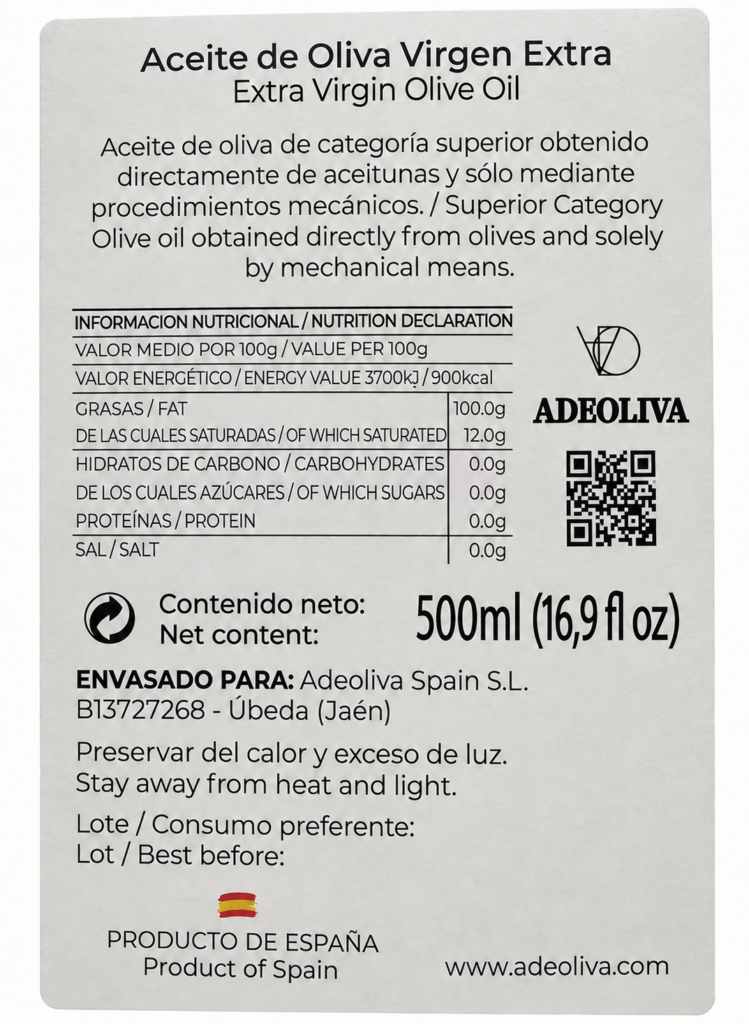
Under the rules above, the sales name (oil category) must appear on the label, together with an explanatory text where applicable:
Extra virgin olive oil (EVOO):
“Superior category olive oil obtained directly from olives and solely by mechanical means“.
Virgin olive oil:
“Olive oil obtained directly from olives and solely by mechanical means“.
Olive oil (*):
“Oil comprising exclusively olive oils that have undergone refining and oils obtained directly from olives”.
(*) This oil is a blend of virgin and refined olive oils. In Spain it is sometimes sold as “mild” or “intense” olive oil; in the US and UK it is often labelled “pure” or “light” olive oil.
Olive pomace oil (**):
“Oil comprising exclusively oils obtained by processing the product obtained after the extraction of olive oil and oils obtained directly from olives” or “Oil comprising exclusively oils obtained by processing olive pomace and oils obtained directly from olives”
(**) This oil is made by blending refined olive pomace oil with virgin oils, giving an edible oil.
Lampante olive oil: not sold to consumers and not fit for consumption unless refined.
Origin of the oil (MANDATORY)
The designation of origin on the label is mandatory for extra virgin olive oil (EVOO) and virgin olive oil. It isn’t required for other oils.
There are several possible cases:
Oil from a single EU country: in order of preference, the options are:
A reference to a Protected Designation of Origin (PDO) or Protected Geographical Indication (PGI);
The country of origin (for example, Product of Spain), or;
The European Union as a whole (Product of the European Union).
If the olives were harvested in one country and milled in another, both must be shown on the label.
Blends of oils from several countries, inside or outside the EU: the label must state, as appropriate:
“blend of olive oils of European Union origin”, or a reference to the EU,
“blend of olive oils not of European Union origin”, or a reference to origin outside the EU,
“blend of olive oils of European Union origin and not of European Union origin”, or a reference to origin within and outside the EU, or
Oil from a single country outside the EU: the label must state the country of origin.
Extraction method and oil characteristics (optional)
For extra virgin olive oil (EVOO) and virgin olive oil, the label may show the following, where applicable:
“First cold pressing”: when the oil was obtained below 27 °C by a first mechanical pressing of the olive paste, in a traditional press system.
“Cold extraction”: when the oil was obtained below 27 °C by percolation or centrifugation of the olive paste.
Sensory characteristics describing the taste and aroma of the oil.
Acidity, which must always be accompanied by the peroxide value, wax content and ultraviolet absorbance.
Olive variety: optional, but it adds value, helping consumers link the oil with the sensory characteristics of each variety (Picual, Arbequina, Royal…).
Harvest year: optional and adds value (for example, “2026/2027 harvest” or “harvested Oct 2026”). It can only be shown when the oil isn’t a blend of two or more harvests.
Integrated or organic production: tells consumers how the oil was produced.
It’s optional, although organic oils usually show it, as it sets them apart from integrated-production oils.
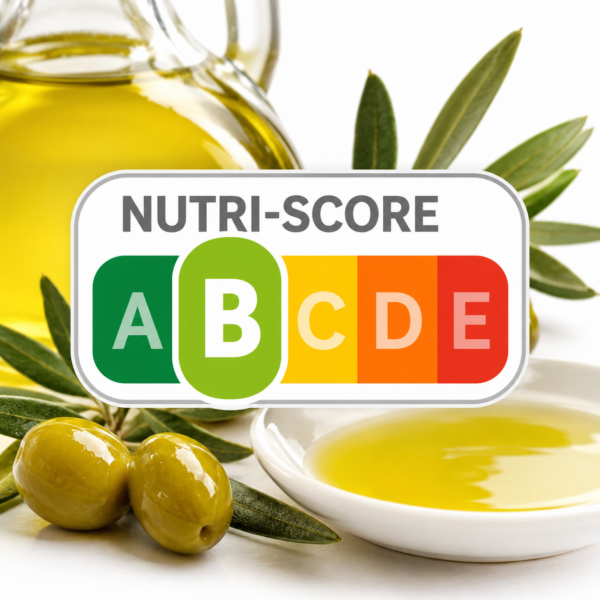
Nutri-Score on olive oil (OPTIONAL)
A few years ago a new front-of-pack label was introduced to show shoppers which foods are “healthier”: the Nutri-Score.
The scale has 5 levels, from A to E, with A foods the healthiest and E the least healthy.
But what is the Nutri-Score based on?
The Nutri-Score is calculated per 100 g or 100 ml from a limited set of nutrients: energy, sugars, saturated fat and salt count against a food, while fibre, protein and the share of fruit, vegetables, pulses and certain oils count in its favour. Looking only at these elements can give some healthy foods a worse score, and vice versa.
For example, it doesn’t take into account: how processed a food is, the quality and source of its protein, sweeteners, or the origin and naturalness of its ingredients…
Some examples critics often point to:
Sweetened flavoured yoghurt (Nutri-Score: B) versus plain Greek yoghurt (Nutri-Score: C): the flavoured yoghurt, with almost 12% sugar, scores better than Greek yoghurt because the latter has more calories and fat. Yet Greek yoghurt would generally be considered the “healthier” choice.
Children’s breakfast cereals(Nutri-Score: B) high in sugar and fat. Many brands get this score simply by adding wholegrains, which is often pure marketing.
Extra virgin olive oil (Nutri-Score: C, now B): for years the algorithm penalised olive oil for its calories and fat per 100 ml, ignoring its antioxidants and polyphenols. Since the 2023 update, olive oil scores B.
These are just a few examples showing that the Nutri-Score algorithm still has limitations.
At EU level the label is currently voluntary, although consumer organisations such as the Spanish OCU have called for it to be mandatory.
It’s a positive step towards healthier eating in Europe, but it still needs improving. So it’s best to use it as a guide but always read the label.
Maximum bottle size
In the EU, olive oil for retail sale is limited to containers of up to 5 litres, with a closure that keeps the oil in good condition after opening.
Other information required on all packaged foods (MANDATORY)
Like any other packaged food in the EU, the label must show:
Best-before date, net quantity, nutrition declaration, storage instructions, name and address of the packer, batch number, etc.
Who checks that the label is accurate?
The bottling company is responsible for checking that the contents match the label, whether the oil is bottled at the olive mill or by another company.
To do this, each bottler must be approved and ensure that it:
Has bottling facilities.
Collects and keeps proof of the origin of the oil it bottles.
Has a storage system that allows it to track the origin of its oils.
The label must include the packer’s registration number.
Can you ask for the label to be checked?
The answer is yes, but not just anyone can make the request.
Each EU country is responsible for enforcing the labelling rules.
A request to check a label or a bottled product can be made by:
Organisations of economic operators in the country (producer associations, inter-branch organisations, producer groups, etc.).
The relevant services of the European Commission.
The control body of another EU member state.
B. LABELLING OLIVE OIL EXPORTED OUTSIDE THE EUROPEAN UNION
Any bottled oil produced in Spain for export outside the EU must fully comply with the rules of the destination country, and the label must be translated into its language.
These olive oil exports also require an export certificate so that markets can be managed and shipments tracked.
In the United States, for example, labels must follow FDA rules: the name of the product, net quantity in both metric and US units (for example 500 ml / 16.9 fl oz), a Nutrition Facts panel in the US format, the name and address of the manufacturer or distributor, and the country of origin (e.g. “Product of Spain”). The USDA grades for olive oil are voluntary.
We hope we’ve answered your questions about olive oil labelling. At Adeoliva we believe in olive oil traceability and strict rules, so that everyone who enjoys our wonderful liquid gold knows exactly what they are buying.
"They are not rules; they are lessons learnt from life."